

What is the AI Content Detector tool?
An AI content detector estimates whether a text was written by an AI chatbot such as ChatGPT. This one analyses four writing signals that differ between typical AI and human writing: how even the sentence lengths are, AI-typical phrases, contractions and vocabulary variety. It gives an AI-likeness score and shows exactly what raised it. It works on English text in your browser, without uploading anything.
How to use the AI Content Detector tool
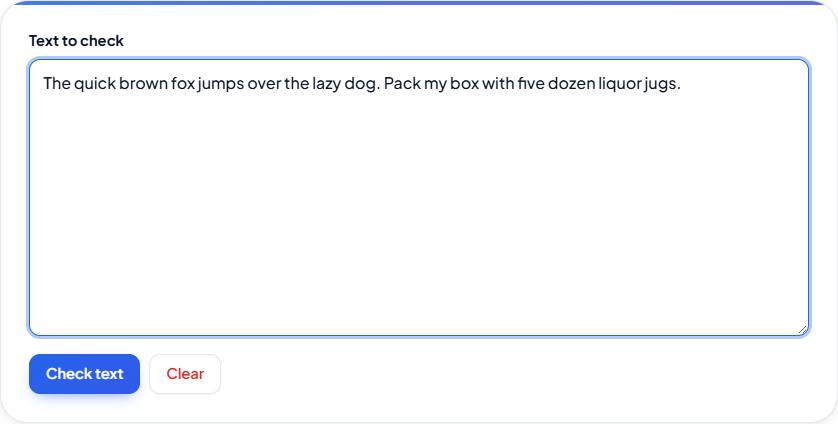
- Paste at least 80 words of English text into the Text to check box.
- Click Check text.
- Read the AI-likeness score and the verdict: Likely AI-generated, Mixed or unclear, or Likely human-written.
- Look at the four signal bars to see which patterns raised the score.
- Review the AI-typical phrases found, shown with how often each appears (up to 15); rewriting them makes text sound more human.
- Click Clear to empty the box and check another text.
Features
- AI-likeness score from 0 to 100%
- Shows the AI-typical phrases it found
- Explains each signal in plain words
- Free, unlimited and private: nothing is uploaded
How does AI detection work?
AI models tend to write very even sentences, reuse the same polished phrases ("moreover", "it is important to note", "delve") and avoid contractions. People usually mix short and long sentences and write more casually. The detector measures these patterns and combines them into one score.
The four signals, exactly
Each signal is shown as a bar from 0 to 100%. Uniform sentence lengths compares how much sentence lengths vary relative to their average (the coefficient of variation): very even sentences push it towards 100%, while a strong mix of short and long ones brings it to 0. AI-typical phrases counts matches from a built-in list of about 60 words and phrases, such as "delve", "tapestry", "plays a crucial role" and "in today's fast-paced world", per 100 words; 1.5 or more matches per 100 words gives 100%. Few contractions counts forms such as "don't" and "it's" per 100 words; none at all gives 100%. Repetitive vocabulary measures how many different words appear in each 50-word stretch of the text, averaged across the whole text, and rises as the range of words narrows.
How the score and verdict are worked out
The score is a weighted average of the four signals: sentence uniformity and AI-typical phrases count for 35% each, and contractions and vocabulary for 15% each. A score of 65% or more is labelled Likely AI-generated, 40% to 64% Mixed or unclear, and below 40% Likely human-written. These thresholds are fixed rules, not a measured probability, so a score of 70% does not mean there is a 70% chance the text came from an AI. The tool does not run a language model and does not compare your text with any database of known AI output.
How accurate are AI detectors?
No AI detector is fully reliable. Formal human writing can score high, and AI text that has been edited or prompted to sound casual can score low. Research has also found that detectors flag writing by non-native English speakers as AI more often. Treat the score as a hint to look closer, never as proof, and never use it alone to accuse a student or writer of cheating.
Use cases
The score is most useful as a writing aid and a prompt for a closer look, not as a verdict on a person.
- Check your own draft for stock phrases and very even sentences before you publish or submit it.
- Edit AI-assisted text so it reads naturally, using the list of phrases found as a to-do list.
- Get a quick second opinion on a submitted article or essay before talking to the writer about how it was produced.
- See how much the score moves when you vary sentence length or use contractions, to learn what makes writing sound mechanical.
Limits and privacy
The checker analyses English text only; the phrase list and contraction patterns are English. It needs at least 80 words and three sentences, and it tells you how many words you have if the text is too short. Sentences are split at full stops, question marks, exclamation marks and line breaks, so bullet lists and headings count as short sentences and can change the uniformity signal. Common words on the phrase list, such as "crucial", "journey" or "additionally", are also used by people. The analysis runs entirely in your browser: the text you paste is not uploaded, saved or sent anywhere.
Frequently asked questions
Can it detect ChatGPT?
It flags the writing patterns that ChatGPT and similar models often produce. Edited or carefully prompted AI text may not be detected.
How much text do I need?
At least 80 words in three or more sentences. Longer texts of 300 words or more give a more meaningful score.
Can a human text score as AI?
Yes. Very formal, even writing with phrases like "furthermore" can score high even when a person wrote it. That is why the score is only a guide.
Does the score show the chance that a text is AI-generated?
No. It is a weighted mix of four writing signals compared against fixed thresholds, not a probability. Use it to see which patterns stand out, not as a percentage chance.
Does it work for other languages?
No. The phrase list and contraction checks are built for English, so results for other languages are not meaningful.
What should I do if my own writing scores high?
Look at which signal is highest. If it is sentence uniformity, vary your sentence lengths; if it is phrases, swap the listed words for plainer ones; if it is contractions, write as you would speak where the tone allows. If you need to show how you wrote something, drafts and notes are far better evidence than any detector score.
Is my text stored?
No. The analysis runs in your browser and your text is never sent anywhere.