

What is the Random Number Generator tool?
A random number generator is a tool that picks numbers by chance from a range you choose. Generate a random number between any two values, or a whole list of them. Choose the minimum, the maximum and how many numbers you need, then decide whether duplicates are allowed and whether the list should be sorted. It is ideal for raffles, lottery picks, classroom activities, sampling and games.
How to use the Random Number Generator tool
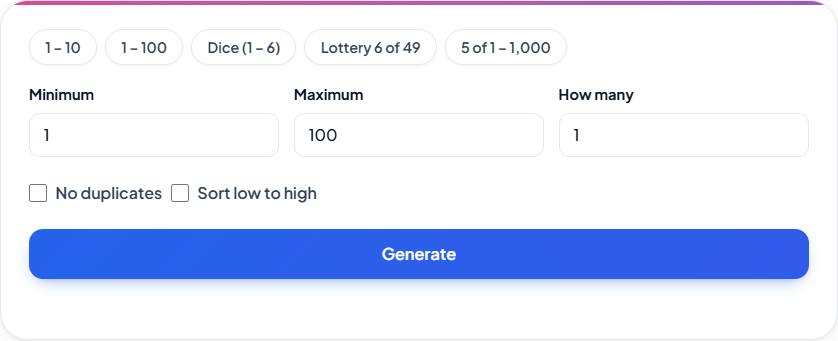
- Type the lowest allowed number in Minimum and the highest in Maximum; negative numbers work too.
- Enter how many numbers you want in How many, from 1 to 1,000.
- Tick “No duplicates” if each number may appear only once.
- Tick “Sort low to high” if you want the list in ascending order.
- Press Generate, or click a preset such as 1 – 100 or Lottery 6 of 49 to fill the fields and draw at once.
- Use Copy all to copy a list of results, separated by commas.
Features
- Any whole-number range, including negative numbers
- Up to 1,000 numbers at once
- No-duplicates mode for raffles and lotteries
- Optional sorting and one-click copy of the results
- Secure, unbiased randomness from your browser
How random are the numbers?
Every result comes from crypto.getRandomValues(), the cryptographically secure random number generator of the Web Crypto API that is built into every modern browser. The tool does not use Math.random() to pick results. It also uses rejection sampling: a random 32-bit value that would make some numbers slightly more likely than others is thrown away and drawn again. This removes the small “modulo bias” found in many simple generators, so every whole number between your minimum and maximum, both included, has exactly the same probability.
Picking numbers without duplicates
Turn on “No duplicates” when each number may appear only once, for example when drawing raffle tickets or lottery numbers. The tool checks first that your range is big enough: you cannot pick 10 different numbers between 1 and 5, and it tells you how many different numbers the range holds. For ranges of up to 20,000 numbers it shuffles the whole range with a partial Fisher-Yates shuffle and takes the first picks; for bigger ranges it draws numbers and simply redraws any it has already used. Either way, every possible set of numbers is equally likely. With duplicates allowed, each number is picked independently, like rolling a die several times, so the same value can come up twice in a row.
Ranges, number formats and presets
Minimum and Maximum accept any whole numbers, including negative ones, as long as the minimum is not larger than the maximum and the range holds no more than 4,294,967,296 values (2 to the power of 32). You can type large numbers in the style you are used to, such as 1000, 1,000 or 1 000. Decimals are not supported: the generator only returns whole numbers. The presets set everything for you and draw straight away: 1 – 10, 1 – 100, Dice (1 – 6), Lottery 6 of 49 (six different numbers, sorted) and 5 of 1 – 1,000 (five different numbers in the order drawn).
Reading the results
When you draw a single number, it is shown large after a short slot-machine style reveal of about 0.8 seconds. The flickering digits during that reveal are only decoration; the result itself was already picked with the secure generator before the animation starts. If your device asks for reduced motion, the number appears immediately. Earlier single draws are listed under “Previous:”, so you can see your last 14 results. When you ask for two or more numbers, they appear as a list with a count above it and a Copy all button.
Use cases
A fair number picker is handy whenever a choice must not depend on anyone's preference.
- Draw raffle winners by numbering the tickets and picking with “No duplicates” ticked.
- Generate a set of lottery numbers with the Lottery 6 of 49 preset or your own range and count.
- Choose a random student, question or page number in class with a quick 1 – 30 range.
- Select a random sample of rows from a numbered list or spreadsheet for checking or testing.
- Replace a lost die in a board game with the Dice (1 – 6) preset, or set any other range for other dice.
Limits and privacy
You can generate up to 1,000 numbers per click, and the range must stay within 4,294,967,296 possible values. Only whole numbers are produced; there are no decimals, weights or custom lists of values (for picking from names, use a wheel instead). The tool does not save your settings or results, so they are gone when you reload the page. All numbers are generated in your browser and nothing is sent to a server.
Frequently asked questions
Can I generate a random number between 1 and 100?
Yes. Set the minimum to 1 and the maximum to 100, or click the 1 – 100 preset, which draws a number straight away.
Can I use it for a pick-a-number game?
Yes. Set a range such as 1 to 100 and generate one number as the secret number, or let each player generate a number and compare. To give every player a different number, set How many to the number of players and tick No duplicates.
Can I generate lottery numbers?
Yes. Use the Lottery 6 of 49 preset, which picks six different numbers and sorts them, or choose your own range and count with “No duplicates” ticked.
How many numbers can I generate at once?
Up to 1,000 numbers per click. Copy all copies the whole list as comma-separated values.
Can I use negative numbers?
Yes. Any whole numbers work, for example a range from -50 to 50.
Is the generator truly random?
It uses your browser's cryptographically secure generator, crypto.getRandomValues(), with rejection sampling so no number is favored. Like all computer randomness it is not based on a physical process, but it is unpredictable and suitable for draws and games.
Why do I get an error with “No duplicates” ticked?
Your range holds fewer different numbers than you asked for. For example, 1 to 5 has only five numbers, so you cannot draw 10 without repeats. Widen the range or lower How many.
Are my numbers stored anywhere?
No. Results are created in your browser and are not uploaded or saved. The list of previous results disappears when you reload the page.