

What is the Readability Checker tool?
A readability checker measures how easy a text is to read, using formulas based on sentence length and word length. Paste an article, essay, email or AI-written draft to get the Flesch Reading Ease score, the US school grade level from five formulas, and a list of long sentences to shorten. Your text is analysed in your browser and never uploaded.
How to use the Readability Checker tool
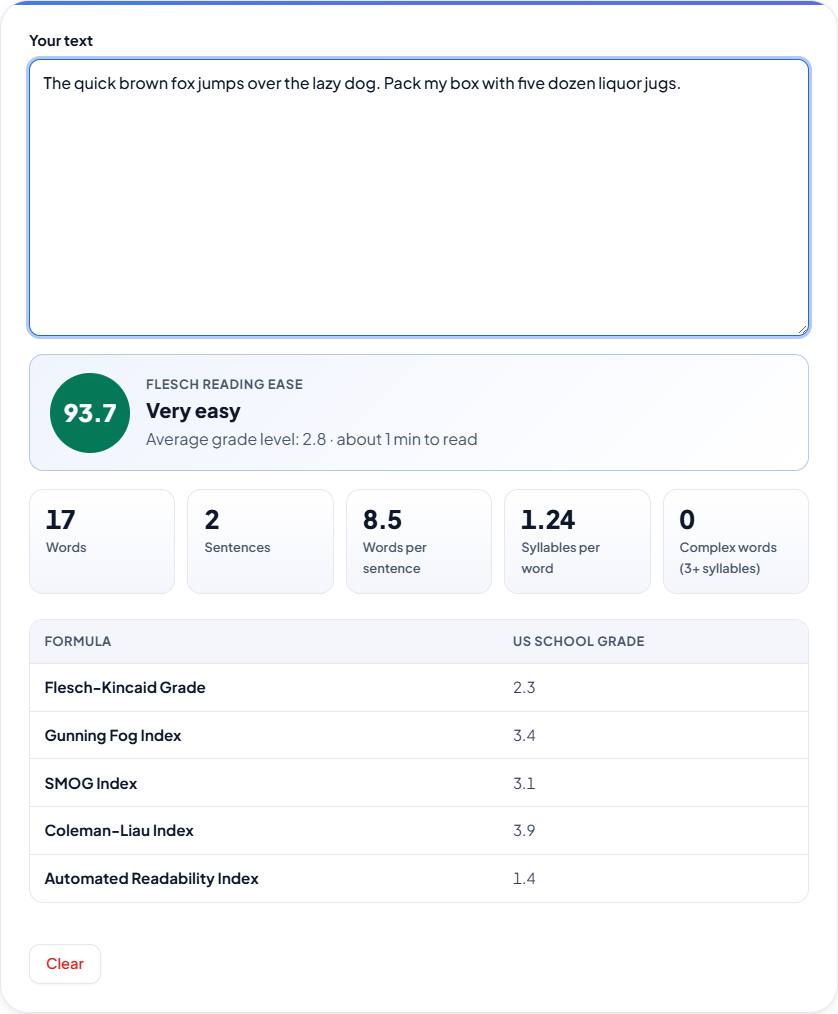
- Paste or type your text into the Your text box; scores appear as soon as there is a sentence.
- Read the Flesch Reading Ease score in the colored circle and the plain-English level next to it.
- Check the average grade level and the estimated reading time under the score.
- Compare the US school grade from each of the five formulas in the table.
- Shorten the sentences listed under “Long sentences to shorten”, starting with the longest.
- Edit your text in the box and watch the scores update, or press Clear to start again.
Features
- Flesch Reading Ease and Flesch-Kincaid Grade Level
- Gunning Fog, SMOG, Coleman-Liau and Automated Readability Index
- Highlights sentences over 25 words
- Instant results; nothing is uploaded
What is a good readability score?
For most websites, blogs and emails, aim for a Flesch Reading Ease score of 60 or higher, which is plain English that most adults read easily, and a grade level of about 8 or lower. Technical and academic writing often scores 30-50, which is fine for expert readers but hard for everyone else. The checker colors the score green from 60 up, amber from 30 to just under 60, and red below 30, and labels it from Very easy (90 and above) down to Very difficult (below 30).
Which formulas does the checker use?
Flesch Reading Ease is 206.835 − 1.015 × (words per sentence) − 84.6 × (syllables per word); higher is easier. The five grade-level formulas each estimate the US school grade a reader needs. Flesch-Kincaid Grade is 0.39 × words per sentence + 11.8 × syllables per word − 15.59. Gunning Fog is 0.4 × (words per sentence + the percentage of complex words). SMOG is 1.043 × √(complex words × 30 ÷ sentences) + 3.1291. Coleman-Liau uses letters instead of syllables: 0.0588 × letters per 100 words − 0.296 × sentences per 100 words − 15.8. The Automated Readability Index is 4.71 × letters per word + 0.5 × words per sentence − 21.43. Here a complex word is any word with three or more syllables. The average grade level shown under the score is the mean of the five formulas.
How words, sentences and syllables are counted
A word is a run of letters, including accented Latin letters, and a contraction such as “don't” counts as one word; numbers on their own are not counted as words. A sentence ends at a full stop, question mark, exclamation mark or ellipsis followed by a space, or at a line break. Common abbreviations such as Mr., Mrs., Dr., Prof., etc., e.g. and i.e. do not end a sentence, and the point in a decimal number such as 3.5 is ignored. Syllables are estimated with a rule of thumb rather than a dictionary: words of three letters or fewer count as one syllable, a silent final e, es or ed is dropped, and each group of vowels (a, e, i, o, u, y) counts as one syllable. Like any such rule, it is off by one for some words, which shifts the scores slightly.
How do I make my writing easier to read?
Split long sentences in two, prefer short everyday words to long ones, use active verbs, and break big paragraphs into smaller ones. These changes raise the Flesch score directly, because it is calculated from words per sentence and syllables per word. The checker lists every sentence over 25 words, longest first, and shows up to five of them with their word count, so you know where to start. The stats row shows words, sentences, words per sentence, syllables per word and complex words, which tells you whether long sentences or long words are pulling the score down.
Use cases
A readability score is a quick, objective check before you publish or send something.
- Check a blog post or landing page against a target such as Flesch 60 or grade 8 before it goes live.
- Make an AI-written draft sound more natural by finding and splitting its longest sentences.
- Simplify instructions, help articles or customer emails so that non-experts can follow them.
- See whether a school essay or report suits the reading level of its intended audience.
- Compare two versions of the same paragraph to see which one is easier to read.
Limits and privacy
The formulas measure only sentence length and word length. They cannot tell whether a text is accurate, well organized or suited to its readers, and a short word can still be unfamiliar. Headings, list items and lines without punctuation each count as a separate sentence, which can make a text look easier than it is, so check running prose where possible. The formulas were designed for English, and on non-English pages the tool shows a reminder that scores are only a rough guide. The reading time assumes 238 words per minute. Your text is analyzed in your browser as you type and is never uploaded.
| Score | Level | Typical reader |
|---|---|---|
| 90-100 | Very easy | Age 11 |
| 60-70 | Plain English | Age 13-15 |
| 30-50 | Difficult | College |
| 0-30 | Very difficult | University graduate |
Frequently asked questions
What is the Flesch Reading Ease score?
It is a score based on average sentence length and syllables per word. It usually falls between 0 and 100, though very simple text can go higher; the checker shows values from 0 to 121. Higher scores are easier: 60-70 is plain English and 90+ is very easy.
What does the grade level mean?
It is the US school grade a reader needs to understand the text. Grade 8 means a typical 13-14 year old can read it.
Why do the five grade levels differ?
Each formula weighs different things. Flesch-Kincaid and SMOG use syllables, Gunning Fog counts words of three or more syllables, and Coleman-Liau and the Automated Readability Index count letters. Looking at the average gives a steadier picture than any single formula.
What counts as a long sentence?
Any sentence of more than 25 words. All of them are counted in the heading, and the five longest are shown so you can shorten them first.
Can I check AI-written text?
Yes. AI drafts often use long sentences and long words; the checker shows which sentences to shorten so the text sounds more natural.
Does it work in other languages?
The formulas were designed for English, so scores for other languages are only a rough guide. The syllable rules are English rules too.
Is my text uploaded or stored?
No. All counting and scoring happen in your browser, and the text is not saved. Press Clear to empty the box.
Is this readability checker free?
Yes. It is free with no sign-up and no word limit, and your text is analysed in your browser, never uploaded.